

Adobe Photoshop’s subscription fees can put a serious dent in your budget, especially if you’re just starting out with photography or design.
A Creative Cloud subscription rings in around $70 per month for the full package or $20 per month for the Photography plan, which adds up annually.
The good news? I’ve spent weeks testing free photo editing software like Photoshop, and I’m here to tell you that you don’t need to break the bank to edit stunning images. While Photoshop remains the industry standard, several free alternatives offer powerful editing capabilities that can handle most of what photographers and designers need.
In this guide, I’ll walk you through the best free Photoshop alternatives. You’ll discover which tools work best for different editing styles, what features each one offers, and how they stack up against Adobe’s flagship software.
In This Article
Best Free Photoshop Alternatives
Here’s a quick overview of our favorite free software like Photoshop.
| SOFTWARE | BEST FOR | COMPATIBILITY |
|---|---|---|
| GIMP | Overall best free Photoshop alternative | MacOS, Windows, Linux, and other desktop operating systems |
| Krita | Digital art, design, and illustration | MacOS, Windows, and Linux |
| Paint.NET | Windows users | Windows |
| Pixlr | Online editing in a browser | Browser-based (IOS and Android apps also available) |
| Photo Pos Pro | Beginners | Windows (can be used on Mac with a Windows Apps emulator) |
Edit for Free, Showcase Like a Pro
Found the perfect free editing tool? Now, make your photos shine with Envira Gallery—create stunning, fast-loading galleries with zero coding required.
1. GIMP – Overall Best Free Photoshop Alternative

| BEST FOR: Professional photographers and advanced users who need extensive editing capabilities |
| KEY FEATURES: Layers, masks, curves, custom brushes, PSD support, 40+ export formats, animation tools |
| PRICING: Free (open-source) |
| PLATFORM COMPATIBILITY: Windows, MacOS, Linux, and other desktop operating systems |
| SKILL LEVEL: Advanced (steep learning curve) |
The GNU Image Manipulation Program, or GIMP, is hands-down the most well-known free alternative to Photoshop. As an open-source solution, GIMP can do almost anything that Photoshop can, and it won’t cost you a penny.
I’ve used GIMP extensively for both professional and personal projects, and I’m consistently impressed by its robust image editing capabilities. The software provides many of the same retouching features you’d find in industry-standard software, including masks, layers, curves, levels, cloning and healing tools, smart selection tools, and custom brushes.
One feature that really stood out to me during testing is GIMP’s built-in file manager and customizable interface. You can adjust your workspace and available tools to suit your specific workflow, which saves a ton of time once you get things set up.
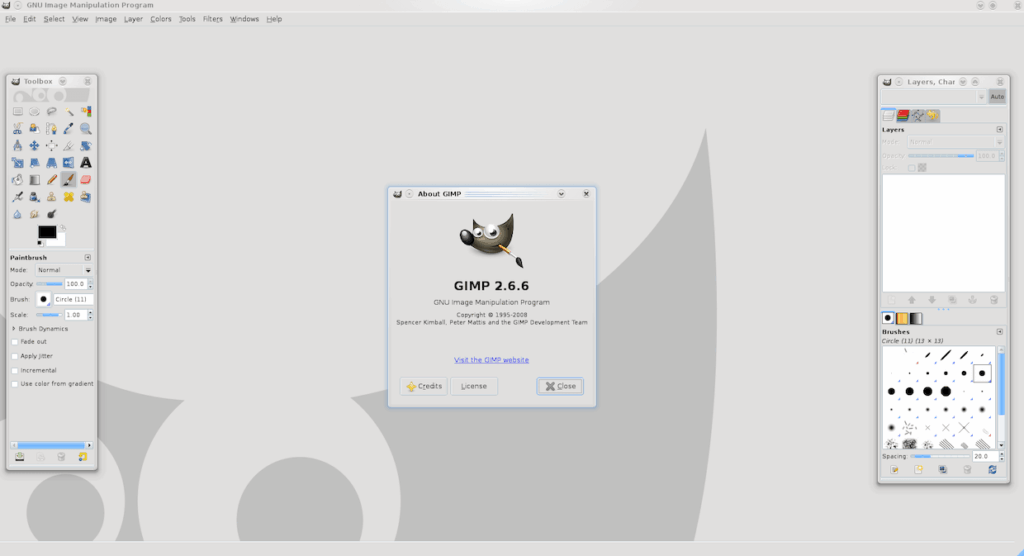
GIMP can even open Photoshop (PSD) files, and you can export images in over 40 file formats. This flexibility makes it easy to collaborate with others who might be using different software.
While other free photo editors can replace some of Photoshop’s functionality, GIMP serves as the most feature-rich Photoshop alternative available today. However, many of the pre-set brushes having similar settings and somewhat limited drawing functionality compared to Photoshop. The software also isn’t very user-friendly, especially for beginners.
MY TAKE
GIMP is the closest thing you’ll get to Photoshop without paying a dime, but it comes with a learning curve just as steep, if not steeper, than Adobe’s software. I won’t sugarcoat it: if you’re expecting a smooth transition from Photoshop, you’ll be frustrated at first. However, GIMP has a large, active community behind it, which means there are plenty of tutorials available to help you get started.
The GIMP community forums are particularly helpful when you run into specific problems. If you’re willing to invest the time to learn the interface and can work around the quirky text editing and large file size issues, GIMP delivers professional-grade results.
PROS
- Extensive advanced features that rival Photoshop
- Compatible with most operating systems including MacOS, Linux, Windows, and more
- Image slicing support
- History toolbar for undoing edits
- Includes an animation package for creating GIFs
- Blending and layer support modes
- Completely free with no hidden costs
CONS
- Complicated UI (user interface) that takes time to learn
- Users often experience issues working with large file sizes and font layers
- Minimal features for drawing, painting, and illustration compared to dedicated art software
- No native support for RAW files (though you can use free third-party RAW editors like Darktable or RawTherapee alongside GIMP)
- Text editing capabilities are notoriously clunky
2. Krita – Best Free Photoshop Alternative for Digital Art

| BEST FOR: Digital artists, illustrators, and designers who need both photo editing and painting capabilities |
| KEY FEATURES: 100+ customizable brushes, pen/tablet support, animation tools, layers, blending modes, templates |
| PRICING: Free (open-source) |
| PLATFORM COMPATIBILITY: Windows, MacOS, and Linux |
| SKILL LEVEL: Intermediate (more intuitive than GIMP) |
Krita is another popular free alternative to Photoshop that I frequently recommend to digital artists and photographers. It’s consistently recommended by creative professionals in forums like Reddit, and after extensive testing, I understand why.
Like GIMP, Krita is a completely free, open-source image editor. What sets Krita apart is that it also offers features similar to Adobe Illustrator, making it particularly well-suited for artists and graphic designers who need both photo editing and illustration capabilities.
Krita supports pens and drawing tablets with pressure sensitivity, has an extensive brush collection (over 100 brushes included, with options to install more), excellent blending modes, and multiple pre-installed templates. This makes it an excellent choice if you’re doing any kind of digital painting or illustration work.
During my testing, I appreciated how similar Krita looks and feels to Photoshop. The toolbars are arranged almost identically, and the dark theme gives you that familiar Adobe experience. This similarity makes the transition from Photoshop to Krita much smoother than with other free alternatives.
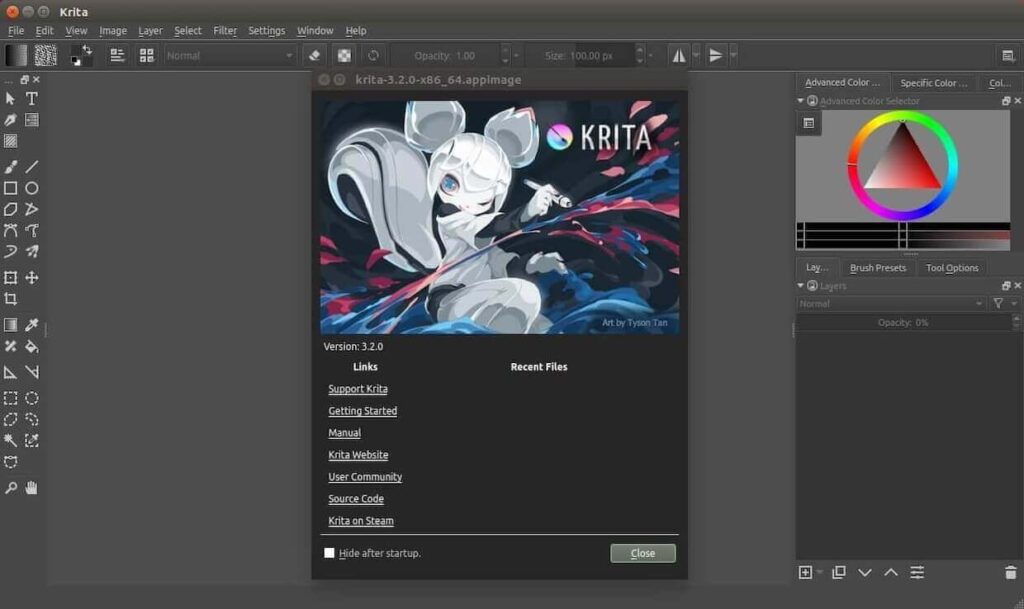
With Krita, you can work on multiple projects simultaneously, and the software handles layered editing, masks, composites, and advanced color grading remarkably well. I was particularly impressed by how the interface, while powerful, doesn’t feel overwhelming.
Unfortunately, I did notice the software can be a bit laggy at times, especially when working with larger files. There’s also no RAW filter included, which might be a dealbreaker for some photographers.
MY TAKE
If you’re looking for a Photoshop alternative that’s more artist-friendly than photographer-focused, Krita is your best bet. The interface feels more intuitive than GIMP’s, and I found the learning curve to be significantly gentler.
What I love about Krita is that it doesn’t try to be exactly like Photoshop—it carves its own path as a hybrid between photo editing and digital painting. The brush engine is honestly exceptional, rivaling even premium paid software.
However, if you’re primarily a photographer who needs RAW processing and doesn’t do illustration work, you might find GIMP more suitable. Krita excels at illustration work, while GIMP provides a broader range of photo-specific editing features.
PROS
- Supports drawing boards to start creative projects from scratch
- Multiple pre-installed templates for various projects
- Extensive selection of effects and filters
- Guides and rulers supported
- Customizable interface with shortcuts to frequently used tools
- Excellent brush engine with over 100 customizable brushes
- Supports animation and frame-by-frame editing
CONS
- No history toolbar
- Can be slow when working with large files
- Limited text features
- No RAW filter for processing camera files
- Not compatible with iPad OS and Android tablets
3. Paint.NET – Best Photoshop Alternative for Windows Users

| BEST FOR: Windows users who want beginner-friendly editing software with fast performance |
| KEY FEATURES: Layers, blending modes, pressure-sensitive pen support, plugin expandability, history tool |
| PRICING: Free (from website) or $14.99 (Microsoft Store) |
| PLATFORM COMPATIBILITY: Windows only |
| SKILL LEVEL: Beginner to Intermediate |
Originally, Paint.NET was intended to be an enhanced version of the Microsoft Paint tool, and you’ll notice many similar features. While Paint.NET might not be as powerful as Photoshop, it delivers a lot of functionality in a much more digestible package, which makes it a great Photoshop alternative for beginners.
I should note upfront that the software is only compatible with Windows PCs. If you’re a Mac user, you’ll want to look at one of the other options on this list.
As a general-purpose raster graphics editor, Paint.NET comes with layers and blending modes, as well as a history tool that makes it easy to undo mistakes. It supports pens and drawing tablets with pressure sensitivity, which is great for digital painting.
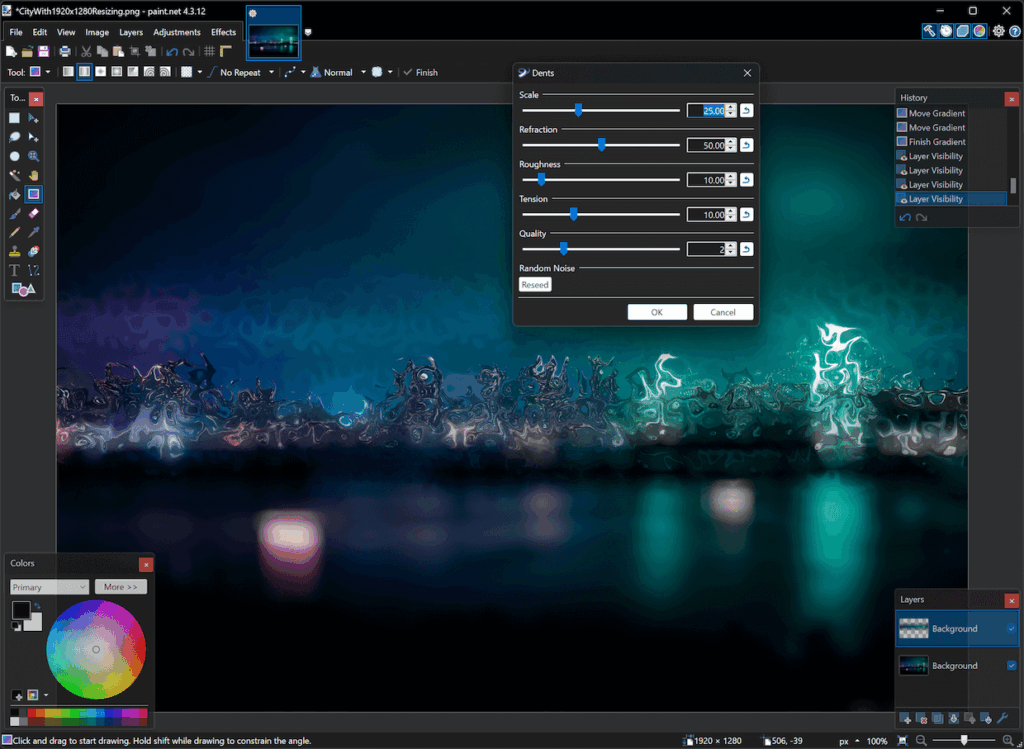
One of the best features I discovered is that Paint.NET is expandable via plugins. You can add effects and custom brushes from Photoshop, and there are numerous third-party plugins available to add support for vectors (SVG), PDFs, PSD files, Adobe Illustrator (AI) files, and more.
If you need free Windows software that’s comparable to Photoshop, Paint.NET is a solid choice. Despite a somewhat outdated interface, I was impressed by how beginner-friendly it is. Plus, it was notably faster than many of the other free photo editing software I tested.
MY TAKE
Paint.NET is the software I recommend when someone says “I just want something simple that works.” It doesn’t try to replace Photoshop feature-for-feature, and that’s actually its strength. The interface feels familiar if you’ve ever used any Microsoft product, and the performance is snappy even on older machines.
The Clone Stamp tool is particularly impressive—it’s accurate and performs at a professional level. Paint.NET handles most of the tasks I typically use Photoshop for, from basic adjustments to more complex compositing work. The biggest limitation is the Windows-only restriction and the 1024 x 1024 export limit on some versions, but if those aren’t dealbreakers for you, this is one of the most practical Photoshop alternatives available.
PROS
- Blending and layer support for complex edits
- History tool for easy undo/redo
- Support for multiple file types
- Well-rounded editing tool that’s beginner-friendly
- Fast performance, even on older computers
- Active plugin community that extends functionality
CONS
- Outdated UI that could use a refresh
- Lack of guide support for precise alignment
- No RAW option for processing camera files
- No slice, patch, or spot healing tool
- Windows-only compatibility
4. Pixlr – Best Free Browser-Based Photoshop Alternative

| BEST FOR: Quick edits and users who need access from any device without installing software |
| KEY FEATURES: AI-powered tools, layers, blending modes, background remover, batch editor, mobile apps |
| PRICING: Free (ad-supported) or $2.49/month for Plus |
| PLATFORM COMPATIBILITY: Any browser (also iOS and Android apps) |
| SKILL LEVEL: Beginner to Intermediate |
Although Pixlr is a browser-based tool, I found it to be just as powerful as many desktop applications I’ve tested. Unlike other free alternatives to Photoshop that are open source, Pixlr was created by AutoDesk—a leading name in computer-aided design software.
One of Pixlr’s biggest advantages is its AI-powered tools that help speed up your editing workflow. During my testing, I really appreciated being able to perform quick edits before tackling more advanced adjustments.
The website offers multiple free options depending on what type of editing you’re doing. Pixlr Editor (E) is the primary tool and features a wide variety of editing capabilities, including blur, sharpen, noise reduction, levels, and curves. There’s also a toolbox similar to GIMP’s, including stamp tools, healing brushes, fills, and more.
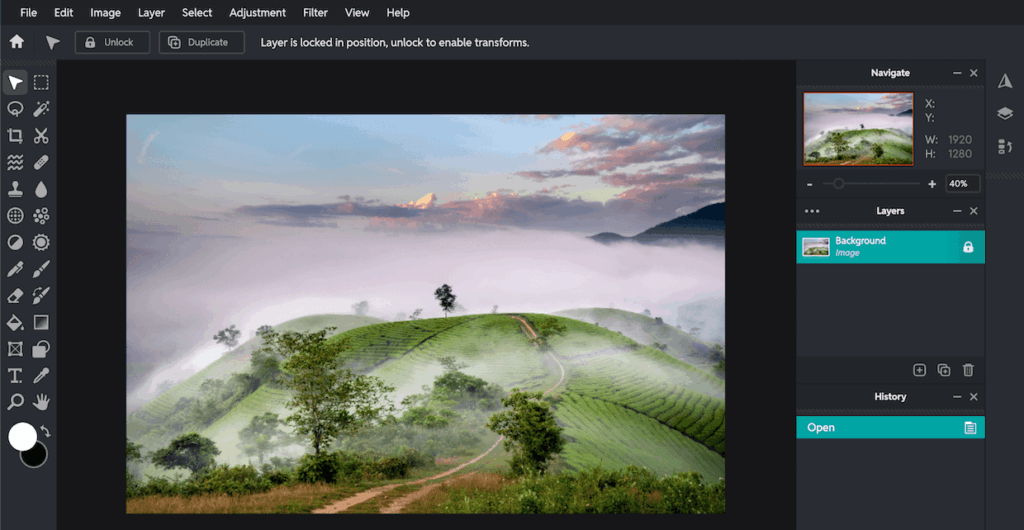
In addition to Pixlr Editor, the website also offers:
- Pixlr Express (X) – geared towards social media with basic photo editing enhancements and resize tools
- Pixlr Designer (D) – similar to Canva, it’s best for templates, collages, and animations
- Pixlr Remove bg (Bg) – a simple AI-powered background remover
- Pixlr Batch Editor (B) – an easy-to-use batch photo editor for processing multiple images
What I really liked during testing was the ability to quickly remove backgrounds from multiple PNG images with AI, before moving to more advanced editing with Pixlr E. This workflow saved me significant time on a recent project.
MY TAKE
Pixlr is perfect for when you need to edit photos but don’t have access to your usual software. I’ve used it countless times when working on a different computer or helping someone make quick adjustments to their images. The AI tools are genuinely helpful, especially the background remover, and save a lot of manual selection work.
However, the free version includes ads that can be distracting, and you’ll need a stable internet connection to use it effectively. For quick edits and simple projects, it’s fantastic. For heavy-duty work with large files, a desktop application will serve you better. The fact that it works across all platforms (including mobile) makes it incredibly versatile.
PROS
- No installation required and accessible on any platform because it’s browser-based
- Offers a mobile app for editing on the go (iOS and Android)
- Layer and blending support for complex edits
- Customizable interface to suit your workflow
- Healing and history tools
- AI-powered features for quick edits
CONS
- No pen tool supported
- Not as extensive file support as Photoshop
- No guides and rulers for precise alignment
- Free version includes ads
- Requires internet connection to use
5. Photo Pos Pro – Best Free Beginner-Friendly Photoshop Alternative
| BEST FOR: Beginners who want to grow into advanced editing with dual-mode interface |
| KEY FEATURES: Dual novice/expert modes, RAW support, layers, masks, healing and clone brushes, scripts |
| PRICING: Free |
| PLATFORM COMPATIBILITY: Windows (can work on Mac with Windows emulator) |
| SKILL LEVEL: Beginner to Advanced (grows with you) |
Photo Pos Pro might be lesser known than other options on this list, but it’s another excellent photo editor that goes head-to-head with Photoshop. The program is specifically designed to be a free, beginner-friendly alternative to Photoshop, and it lived up to my expectations during testing.
As an advanced editing software, Photo Pos Pro is packed with features similar to Photoshop, including layers and masks, as well as healing and clone brushes. You can create and save filters that you want to use in future projects, and there are even options for scripts and batch editing to save time on repetitive tasks.
What I particularly appreciated about Photo Pos Pro is the dual interface system. It provides a novice layout for essential editing enhancements, or you can switch to the advanced layout for fine-tuning adjustments like manual curves and level adjustments. This makes it easy to grow with the software as your skills improve.
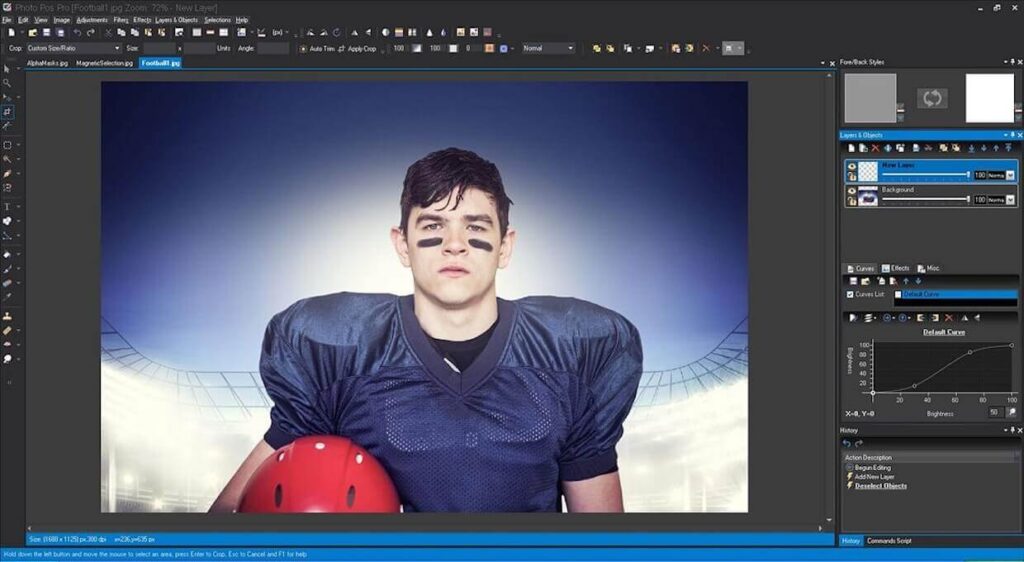
The software supports RAW files, which is a huge plus for photographers working with high-quality camera images. It also comes with plugins to expand its capabilities beyond the default feature set.
My biggest issue with Photo Pos Pro is that the software was occasionally slow during my testing, particularly when working with larger files. There’s also an export limit of 1024 x 1024 pixels, which could be problematic if you need to work with high-resolution images.
MY TAKE
Photo Pos Pro is the perfect stepping stone for photographers who are outgrowing basic editors but aren’t ready for GIMP’s complexity. I love the concept of the dual-mode interface. You can start in novice mode and gradually transition to expert mode as you learn. The RAW file support is a standout feature at this price point (free!), and the available tutorials make it easy to learn.
However, the 1024 x 1024 export limitation is frustrating if you’re working with high-resolution images, and the software can feel laggy with large files. It’s also Windows-only natively, so Mac users will need an emulator. If you can work within these constraints, it’s an excellent choice for learning photo editing without feeling overwhelmed.
PROS
- Customizable interface with both novice and expert modes
- Supports RAW files for professional photography
- Ample tutorials available to help you learn
- Support for layers and masks
- Intuitive feature selection
- Script support for automation
CONS
- Can be laggy when working with large files
- Software sometimes behaves unexpectedly in advanced mode
- Size of exported files is limited to 1024 x 1024 pixels
- Windows-only (requires emulator for Mac)
Frequently Asked Questions
1. What is the best free alternative to Photoshop?
Based on my testing, GIMP is the best free alternative to Photoshop overall. It’s a powerful, open-source tool with an extensive feature set and customization options that rival Adobe’s offering. GIMP supports a wide range of file formats and integrates with multiple programming languages.
However, GIMP has a steeper learning curve compared to Photoshop and may require installing plugins for some features. If you’re willing to invest time in learning the interface, GIMP can handle nearly everything Photoshop can do.
Depending on your specific needs, there are other excellent free image editing software options like Photoshop. For example, Photopea is a free, web-based photo editor that closely resembles Photoshop in both functionality and interface, making it a convenient browser-based solution without software installation.
If you’re a photographer, I recommend Darktable as a great alternative to Lightroom, while Inkscape is a closer match to Adobe Illustrator for vector work.
3. Is GIMP as good as Photoshop?
GIMP is a powerful free alternative that can handle many of the same tasks as Photoshop, but whether it’s “as good” depends on your specific needs. Photoshop is widely recognized for its advanced tools, seamless integration with other Adobe products, and superior pixel manipulation. It offers better layer management and native compatibility with RAW files, making it ideal for complex editing tasks and photos for prints.
GIMP, on the other hand, is completely free and focuses primarily on digital photography. While the interface isn’t as intuitive for newcomers, it offers many similar features. I found that GIMP’s open-source nature allows for continuous development and updates from a dedicated community.
The main differences I noticed during testing include GIMP’s lack of some professional features like CMYK color space support, smart objects, and native RAW processing. GIMP also has notoriously clunky text editing capabilities. However, for most amateur and intermediate users, GIMP provides more than enough functionality at zero cost.
4. Are online photo editors good Photoshop alternatives?
Many online tools offer free photo editing software like Photoshop, and they can be excellent alternatives depending on your needs. During my testing, I found that while most aren’t as feature-rich as Photoshop, they’re perfect for users seeking convenience and free access to core editing features.
These web-based photo studios are ideal for quick edits, basic retouching, and creating social media graphics. I frequently use Pixlr and Photopea for quick projects when I don’t want to open desktop software. They’re particularly handy when you’re working on a computer that doesn’t have your usual editing software installed.
For more intensive work requiring advanced features like those found in professional-grade alternatives (Pixelmator Pro, Affinity Photo, or Skylum Luminar Neo), a desktop application is often the better choice.
Pro Tip: Most reputable online editors have strict privacy measures in place, but I always recommend checking the privacy policy before uploading sensitive images to their servers. Some services may use your uploaded images for training AI models or other purposes unless you opt out.
5. What is the simplest free photo editor?
From all the software I tested for this article, Pixlr was the simplest free photo editor to use. It’s browser-based, which means there’s no installation required, and it also offers a mobile app for editing on the fly.
What I appreciate about Pixlr is that it manages to offer a robust set of tools while remaining accessible to beginners. You get quick-edit AI tools for common tasks, along with advanced features like layers, drawing tools, and brushes when you need them.
Photopea is another simple, free option that works entirely in your browser. If you’re looking for a more feature-rich desktop editing app that’s still user-friendly, I recommend Krita. While it has a learning curve, the interface is more intuitive than GIMP’s, and it’s particularly great if you do any illustration work alongside photo editing.
6. Can I edit RAW photos with free Photoshop alternatives?
Yes, several free Photoshop alternatives support RAW photo editing, though the experience varies. Photo Pos Pro includes native RAW support, which I found works well for basic RAW processing.
For GIMP, you’ll need to pair it with a third-party RAW editor like Darktable or RawTherapee. I typically process my RAW files in Darktable first, then bring them into GIMP for additional editing. While this adds an extra step to your workflow, both Darktable and RawTherapee are completely free and offer professional-grade RAW processing capabilities.
Krita doesn’t include RAW processing, so you’ll want to convert your files to JPEG or TIFF before importing. Paint.NET also lacks native RAW support, though plugins are available to add this functionality.
If RAW editing is a priority for you, I recommend checking out Darktable as your primary RAW processor. It’s a powerful, free alternative to Lightroom that I cover in detail in my guide to Lightroom alternatives.
7. Do free Photoshop alternatives support PSD files?
Most of the free Photoshop alternatives on this list offer some level of PSD support, but the quality varies. GIMP can open and work with PSD files, though I’ve noticed it sometimes handles them a bit clumsily—particularly with more complex features like smart objects and certain adjustment layers.
Krita can read PSD files, which is handy for migrating old projects, but you shouldn’t expect full Photoshop parity. Smart objects and some adjustment layers may not transfer properly in my experience.
Pixlr supports PSD files and does a decent job preserving layers and basic edits. Paint.NET doesn’t support PSD files natively, but plugins are available to add this capability.
If you need to work extensively with PSD files, Photopea is your best bet. It’s a browser-based editor that fully supports the PSD format for both opening and saving files, and it’s completely free to use.
So there you have it—the best free alternatives to Photoshop based on my hands-on testing. Whether you’re a hobbyist photographer, a budding designer, or someone just looking to edit photos without the subscription fees, there’s a tool on this list that can meet your needs.
Remember, the “best” alternative really depends on your specific requirements. If you need the most robust feature set and don’t mind a learning curve, go with GIMP. For digital artists and illustrators, Krita is hard to beat. Windows users looking for simplicity should try Paint.NET, while those wanting zero-installation editing will love Pixlr. And beginners who want to ease into advanced editing will appreciate Photo Pos Pro’s dual-mode interface.
Not using Envira Gallery? Get started today!
If you enjoyed this article, be sure to check out How to Optimize Images for Web (WordPress Best Practices).
Don’t forget to follow us on Facebook and X (Twitter) for the best photography tips, resources, and WordPress tutorials.






Thanks for writing this in-depth review.
Thank you, This list was very helpful.
I went to download paint.net from the Microsoft store but, I found out it was not free. It was approx 10 dollars to purchase. Were you aware of that or is there another way to get the software for free? Thanks.
Hi Dave, there are two versions of paint.net available. You can download the free version on the website or purchase the paid version from the Microsoft store.
Great list, but it sertainly lacks Photodiva, it’s an amazing portrait editor that is free and pretty lightweight!
Thanks for the tip Mary, we’ll check it out! ?
Nice list, but curious why Luminar Neo isn’t mentioned here?
Great question Nardon! This particular list focuses on completely free Photoshop alternatives, which is why Luminar Neo isn’t included. Since it only offers a 7-day free trial before requiring a subscription, it didn’t quite fit the criteria for this roundup.
That said, we’re big fans of Luminar Neo and covered it in detail in our Ultimate Guide to the Best Photo Editing Software for Photographers if you’re interested in a more comprehensive look at paid and free options. Thanks for reading!
You should update this to include Affinity Studio – it’s completely free unless you want the AI features. Includes the former Affinity Photo, Affinity Designer and Affinity Publisher, all updated.
Thanks for the tip Paddy! We also like Affinity a lot. Now that it’s become fully free recently, we’ll definitely add it to the list in the next update. 🙂